
‘Magnifica Humanitas’: Pope Leo’s first encyclical places AI at service of humanity, not power
 Caroline Molloy
Pope Leo XIV published his first encyclical, Magnifica Humanitas, May 25, warning that artificial intelligence (AI) and other technological advances pose moral challenges that could reshape humanity’s understanding of truth, work, relationships, and human dignity.
“Humanity, created by God in all its grandeur, is today facing a pivotal choice: either to construct a new Tower of Babel or to build the city in which God and humanity dwell together,” the encyclical, subtitled “On Safeguarding the Human Person in the Time of Artificial Intelligence,” opens.
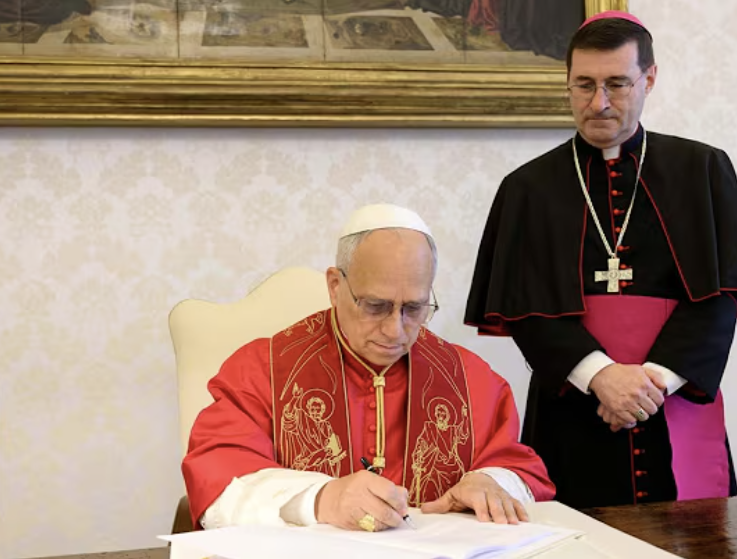
Pope Leo signed the encyclical May 15, the 135th anniversary of Pope Leo XIII’s 1891 encyclical Rerum Novarum, which addressed work, labor, and the unique challenges posed by the Industrial Revolution.
Magnificent humanity
Following Pope Leo XIII’s example, Magnifica Humanitas builds on Rerum Novarum and identifies AI, robotics, and other technologies as the defining factors of the age.
Pope Leo asserts that technology is not inherently evil but emphasizes that, as a tool, it conforms to the wishes of those who wield it. As such, he urges that safeguards and regulations be developed and implemented in ways that protect the common good, encourage flourishing and prosperity, and uphold the dignity of the person and human work.
A dynamic approach faithful to the Gospel
In the first chapter of Magnifica Humanitas, Pope Leo positions technological advances in the context of Catholic social doctrine, saying that the “new things” of each era require careful consideration and teaching from the Church.
“[A]rtificial intelligence should not be considered as merely yet another theme to be studied or an emergency to be managed, but rather as a development that challenges the categories of Social Doctrine from within, entailing its further development in fidelity to the Gospel,” he writes.
The Church’s social teaching is not “an external code of ethics imposed from above,” the Pontiff adds, but rather the result of dialogue with humanity for centuries in response to “new things.” He emphasizes that the Church accompanies humanity throughout the challenges progress can bring but maintains a distinction between ecclesial and political entities.
Foundations and principles of the social doctrine of the Church
Pope Leo further calls for technology to be used in ways that respect human dignity, which is rooted in man’s creation in the image and likeness of God. He cautions against jeopardizing human rights through technological progress and, citing the Catholic principles of solidarity and subsidiarity, urges that digital platforms and technologies be placed at the service of everyone without exclusion, guided by a desire to promote the common good.